
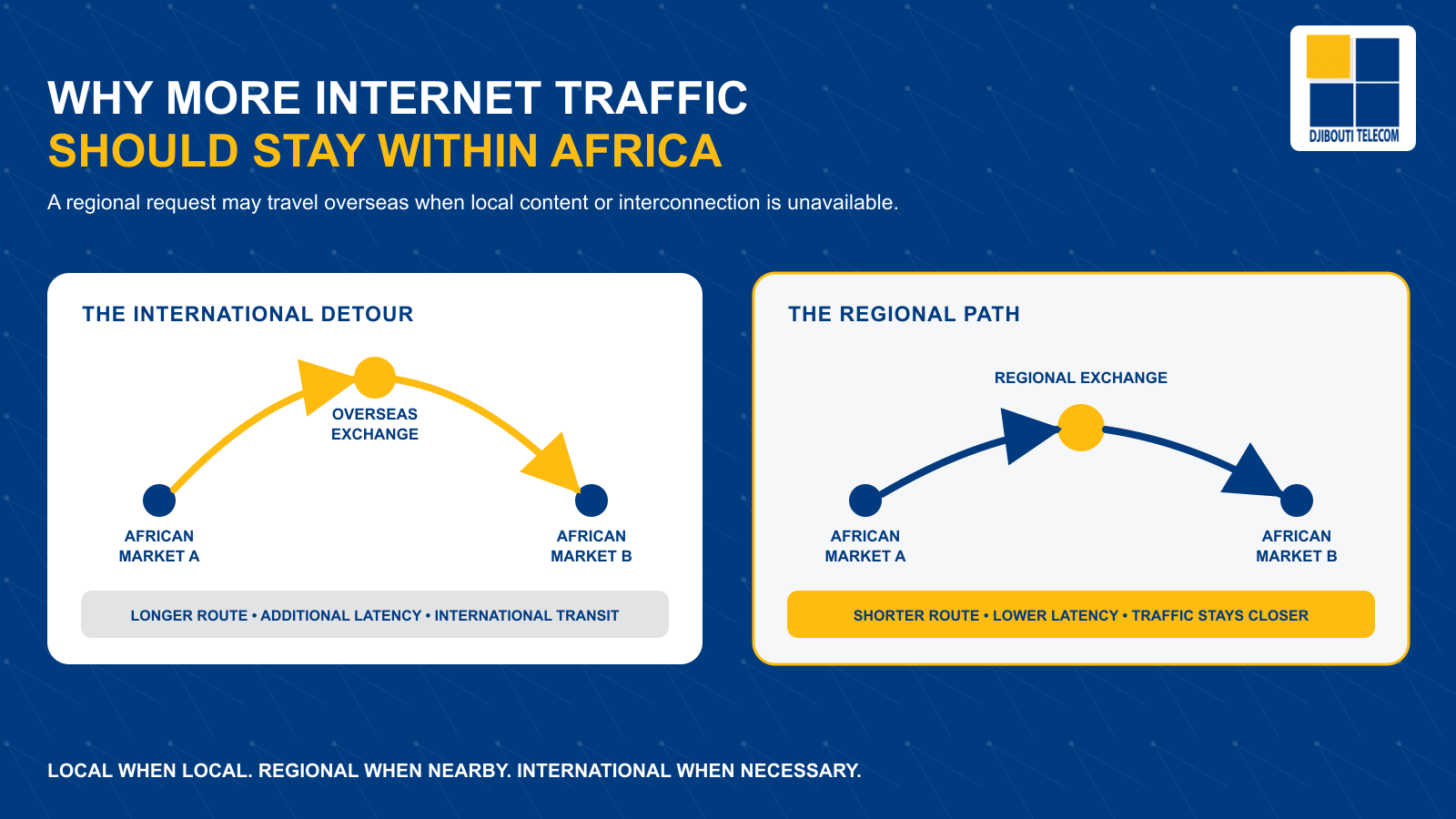
A request sent from one African country to a service in another may travel outside the continent before it reaches its destination. The route is determined by where content is hosted, which networks are connected, and the commercial and technical arrangements between them. Geography alone does not decide the path.
This international detour is sometimes necessary. Much of the content used in Africa is still hosted elsewhere, and global transit remains essential. But when traffic generated and consumed within Africa leaves the continent unnecessarily, users and network operators pay a price in additional distance, delay and international capacity.
Keeping more traffic within Africa is therefore not a case for isolation. It is a case for better interconnection: making local and regional routes available when they are the most efficient option, while retaining strong links to the rest of the world.
Internet traffic follows network agreements, not the map
The Internet is a network of networks. An Internet service provider does not automatically exchange traffic directly with every other provider. Traffic follows the paths available through transit providers, private interconnections and Internet Exchange Points.
If two networks in neighbouring countries do not have a direct or regional exchange arrangement, their traffic may pass through an established hub outside Africa. This practice is often called “tromboning”: local or regional traffic travels over an international route before returning closer to where it started.
European exchange points developed early, attracted many networks and content providers, and offered dependable access to global routes. Many digital services used in Africa have also been hosted in overseas data centres. Buying established international transit may once have been simpler than arranging several regional connections.
The result is that the shortest physical route may not be the route used by the network.
Local exchange reduces distance, delay and avoidable cost
An Internet Exchange Point, or IXP, gives participating networks a shared place to exchange traffic. If the destination network or a local copy of the requested content is available at the exchange, traffic can remain in the country or region rather than using an international transit route.
The effect can be measured. An Internet Society study of Kenya and Nigeria found that local exchange reduced latency and international transit costs in both markets. The original 2012 study recorded average latency falling from 200–600 milliseconds to 2–10 milliseconds in Kenya, and from 200–400 milliseconds to 2–10 milliseconds in Nigeria. These are historical case-study results, not current continent-wide benchmarks, but they show the practical difference that local interconnection can make.
The organisation’s 2020 update found that the Kenya Internet Exchange Point had grown from 1 Gbps of peak traffic in 2012 to 19 Gbps, with estimated annual cost savings reaching US$6 million. Nigeria’s exchange grew from 300 Mbps to 125 Gbps, with estimated annual savings of US$40 million. The same report found that large international content providers had installed edge caches or points of presence in both countries.
Lower latency affects daily services. Pages respond more quickly, video calls suffer less delay and cloud applications feel more immediate. Operators can also reserve international capacity for traffic that genuinely needs to cross continents.
An IXP cannot localise content that is hosted elsewhere
IXPs are important, but they do not solve the problem alone. Traffic can stay closer to users only when the required content or service is available locally or regionally.
That requires several parts of the infrastructure chain to work together:
- Data centres that can host applications, platforms and content caches;
- National and cross-border fibre connecting users, operators and facilities;
- Cable landing stations and international systems providing global reach;
- IXPs, private peering and carrier interconnection;
- Reliable power, cooling, physical security and network operations;
- Commercial demand that justifies local hosting and additional network presence.
A cable landing adds international capacity whilst the terrestrial network carries it inland. A data centre provides a location for equipment and content whilst an IXP allows networks to exchange traffic efficiently. None of these assets creates a strong regional Internet market by itself.
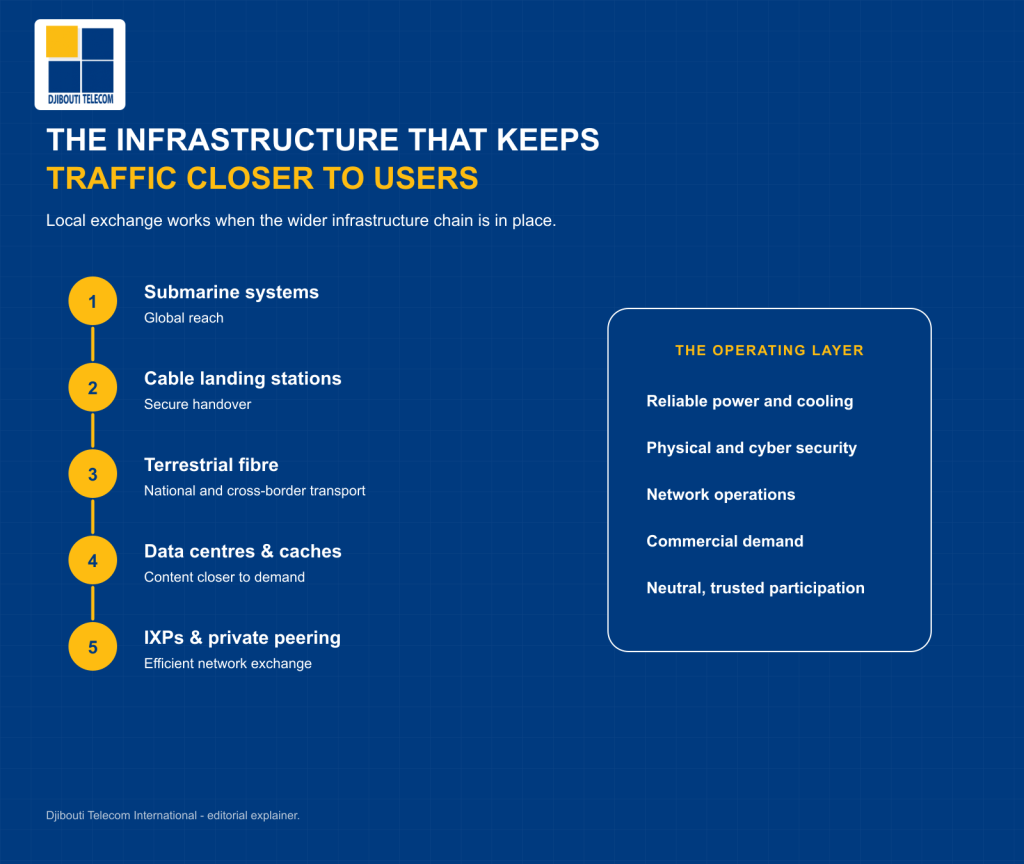
The commercial relationships matter as much as the physical infrastructure. Networks must decide to peer. Content providers need a reason to install a cache or point of presence whilst data centre operators need sufficient demand. Regulators and public institutions can support neutral exchange, cross-border connectivity and predictable investment conditions.
Local traffic also improves resilience, within limits
Local and regional exchange can keep some services available when an international cable route is disrupted, provided the service is hosted nearby and the relevant networks remain connected.
The East African submarine cable outages of May 2024 demonstrated both the value and the limits of this approach. The Internet Society found that local IXP traffic continued during the disruption, but the effect varied by country and by the availability of local content and network connections. Services hosted overseas were still exposed to the loss of international routes.
This distinction matters. Localisation does not replace international resilience. African networks still need diverse submarine systems, terrestrial alternatives and enough capacity to reroute traffic during an outage. Local exchange complements those investments by reducing the amount of traffic that depends on an international round trip in the first place.
For operators, the objective is not to keep every packet within national borders. It is to give traffic a sensible set of options: local when the service is local, regional when the destination is nearby, and international when the content or user is elsewhere.
Africa’s bandwidth growth raises the value of regional exchange
Demand is moving quickly. TeleGeography reported that Africa’s international Internet bandwidth grew at a compound annual rate of 38% between 2021 and 2025, the fastest rate of any region in its dataset. Global international bandwidth reached 1,835 Tbps in 2025.
This growth reflects wider broadband use, more connected devices and rising demand for bandwidth-intensive applications. It also strengthens the case for hosting and exchanging more traffic within Africa. If every increase in regional demand produces a matching increase in avoidable international transit, costs and exposure grow with it.
The opportunity is larger than national localisation. A service hosted in one African market may serve users in several neighbouring countries if cross-border fibre, regional peering and commercial arrangements support an efficient route. This is how separate national networks begin to function as a regional market.
Djibouti’s operating context is relevant here. The country sits on international cable routes linking Africa, the Middle East, Europe and Asia. Djibouti Telecom’s network combines multiple submarine cable systems with terrestrial links to neighbouring markets. This infrastructure provides global reach; the wider task is to connect that reach with more regional exchange, hosting and distribution of content.
That is also why terrestrial corridors matter. Submarine cables bring capacity to the coast, but regional traffic cannot remain regional without inland routes that connect landing stations, data centres, operators and users across borders.
Progress should be measured by the route traffic actually takes
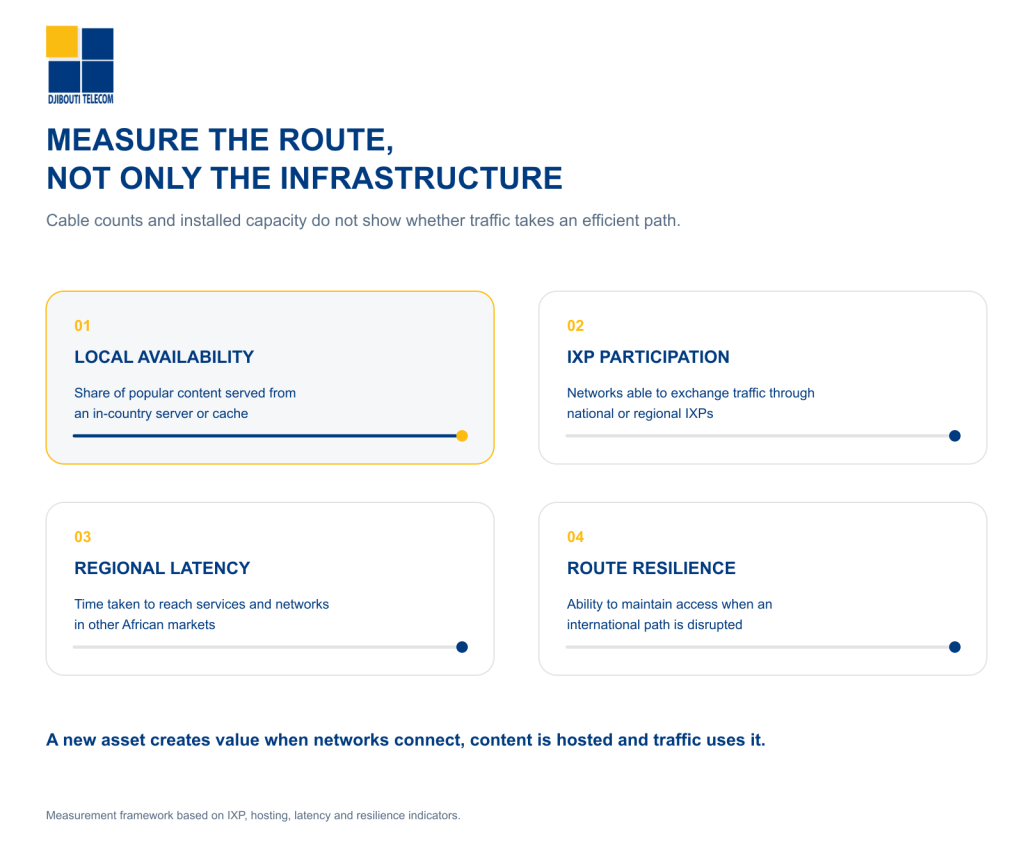
Cable counts and installed capacity are useful indicators, but they do not show whether African traffic is taking an efficient path. Better measures include the share of popular content available from an in-country server or cache, the number of networks exchanging traffic at IXPs, latency between African markets, and the ability to reach regional services without leaving the continent.
These measures reveal where investment is working and where gaps remain. They also discourage a narrow focus on infrastructure announcements. A new cable or data centre has greater value when networks connect to it, content is hosted there and traffic uses it.
The African Union’s Internet Exchange System programme was established around the same principle: local and regional exchange can improve affordability, bandwidth use and latency. Recent ITU guidance for Central Africa likewise identifies national and subregional IXPs, content delivery networks and data centres as practical ways to reduce the cost of international Internet connectivity.
The work is operational rather than symbolic. It requires sustained coordination between carriers, Internet service providers, IXPs, data centres, content networks, cloud providers, regulators and governments. Each participant controls a different part of the route.
Africa will continue to depend on international connectivity, as every region does. The stronger objective is to ensure that African traffic does not cross an ocean simply because a local or regional path is missing.
As demand grows, the quality of the continent’s Internet will depend increasingly on where content is hosted, where networks meet and how easily traffic can move between African markets. More regional exchange will not reduce Africa’s connection to the world. It will make that connection more efficient and give African networks greater control over the journeys their traffic takes.