
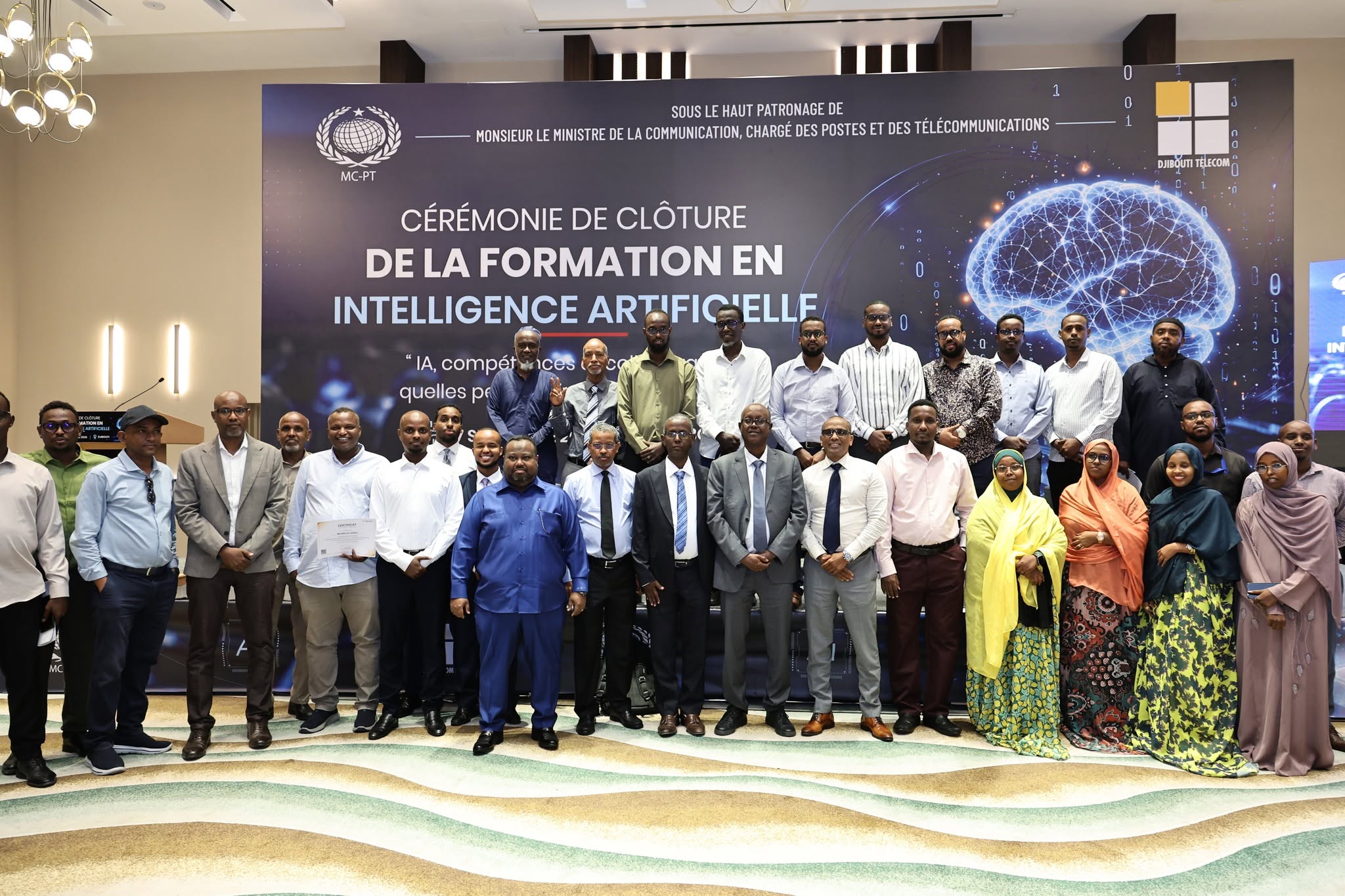
Djibouti Telecom has completed a 10-day artificial intelligence training programme for 35 engineers. The course examined how AI could address specific operational and customer-service requirements within the telecommunications sector.
Participants received their certificates at a closing ceremony held at the Ayla Grand Hotel in Djibouti on 17 September 2026. The event took place under the patronage of Mr Mohamed Abdoulkader Moussa Helem, Minister of Communication, responsible for Posts and Telecommunications.
Mr Mohamed Assoweh Bouh, Director General of Djibouti Telecom, and Mr Mahdi Hirab, Director General of AI-Sense and the programme’s expert trainer, also addressed the ceremony.
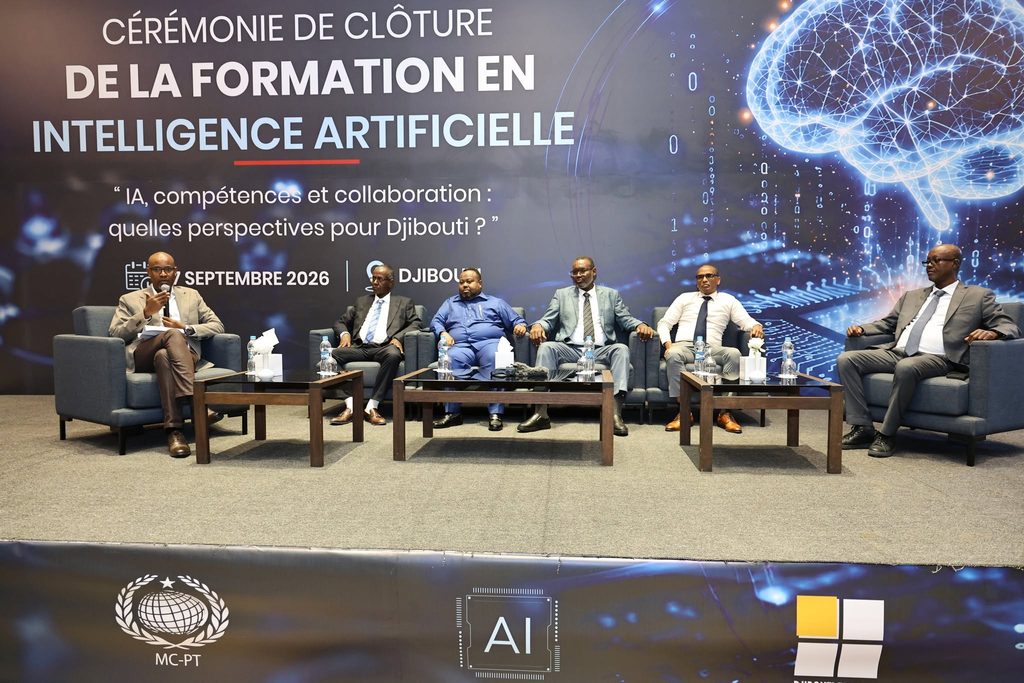
The event included a panel discussion on the theme, “AI, skills and collaboration: what prospects for Djibouti?”
Six telecom use cases provided the basis for the training
The programme focused on situations that Djibouti Telecom’s teams encounter in their work. Participants examined six potential applications of AI:
- Assisting contact-centre teams;
- Detecting fraud and SIM-swap activity;
- Reducing energy use across the radio network;
- Supervising the core network;
- Supporting OSS/BSS teams through AI-based tools;
- Improving customer retention and campaign targeting.
These were training use cases, not announcements of systems already deployed by Djibouti Telecom. Their purpose was to help participants assess where AI may be useful, what data each application would require and how the proposed tool would compare with existing methods.
The course started with the business problem
Mr Mahdi Hirab explained that the programme was initially designed to concentrate on AI tools. Discussions with participants changed the emphasis.
Before working with the technology, the group examined where AI should be used, why it would be appropriate and what implementation could cost. Commercial and operational considerations were discussed alongside the technical work.
Participants then developed AI applications during the course and compared their results with tools already in use. According to Mr Hirab, this gave the group an initial practical understanding of the technology. Further work will be needed to cover the different stages of an AI project in greater depth.
Djibouti Telecom is preparing its teams for changes in telecom operations
In his address, Mr Mohamed Assoweh Bouh placed the training within Djibouti Telecom’s work on skills development and digital services.
He explained that the company wants its teams to understand how AI could affect telecommunications operations and service delivery. This requires employees who can evaluate the technology, identify suitable uses and contribute to its implementation.
AI was presented as a means of improving defined areas of work rather than as an objective in itself. For Djibouti Telecom, any proposed application must be judged by its contribution to operational performance, service quality or the customer experience.
The programme also gave participants from different areas of the company a common basis for discussing AI projects. Engineers need to understand the operational requirement behind an application, while business teams need a realistic view of the data, infrastructure and technical work involved.
The Minister called for an AI roadmap based on practical value
Mr Mohamed Abdoulkader Moussa Helem said Djibouti Telecom should define an AI roadmap that is consistent with Djibouti’s national strategy.
He cautioned against adopting AI simply because the technology is receiving widespread attention. The company should first identify the areas where it can create measurable value for operations and customers.
His remarks identified several requirements for this work: suitable skills, computing infrastructure, usable data and the right partnerships. These elements will determine whether a proposed application can move beyond an experiment and operate reliably within the company.
The Minister also described human capital as Djibouti’s primary resource. He encouraged Djibouti Telecom to continue investing in training because AI tools and working methods are changing quickly.
Training is the first stage of project development
The closing ceremony brought together government representatives, Djibouti Telecom management, programme participants and the training team. A panel discussion considered the skills and cooperation needed to apply AI in Djibouti, followed by the presentation of completion certificates.
A sequence displayed during the event captured the intended process:
Train → Experiment → Collaborate → Transform
Each stage depends on the one before it. Training gives staff a working knowledge of the technology. Experimentation tests an idea against real operational requirements. Collaboration brings together technical, commercial and management teams. Organisational change should follow only when the evidence supports it.
The next step is to therefore decide which of the six use cases merit further testing. Each proposed project will need a clearly defined problem, an accountable team, appropriate data and a method for measuring results. Security, cost and integration with Djibouti Telecom’s existing systems must also be assessed.
The 10-day programme has given 35 engineers a shared foundation for that work. Its value will be determined by how carefully the company selects, tests and evaluates the applications that follow.