
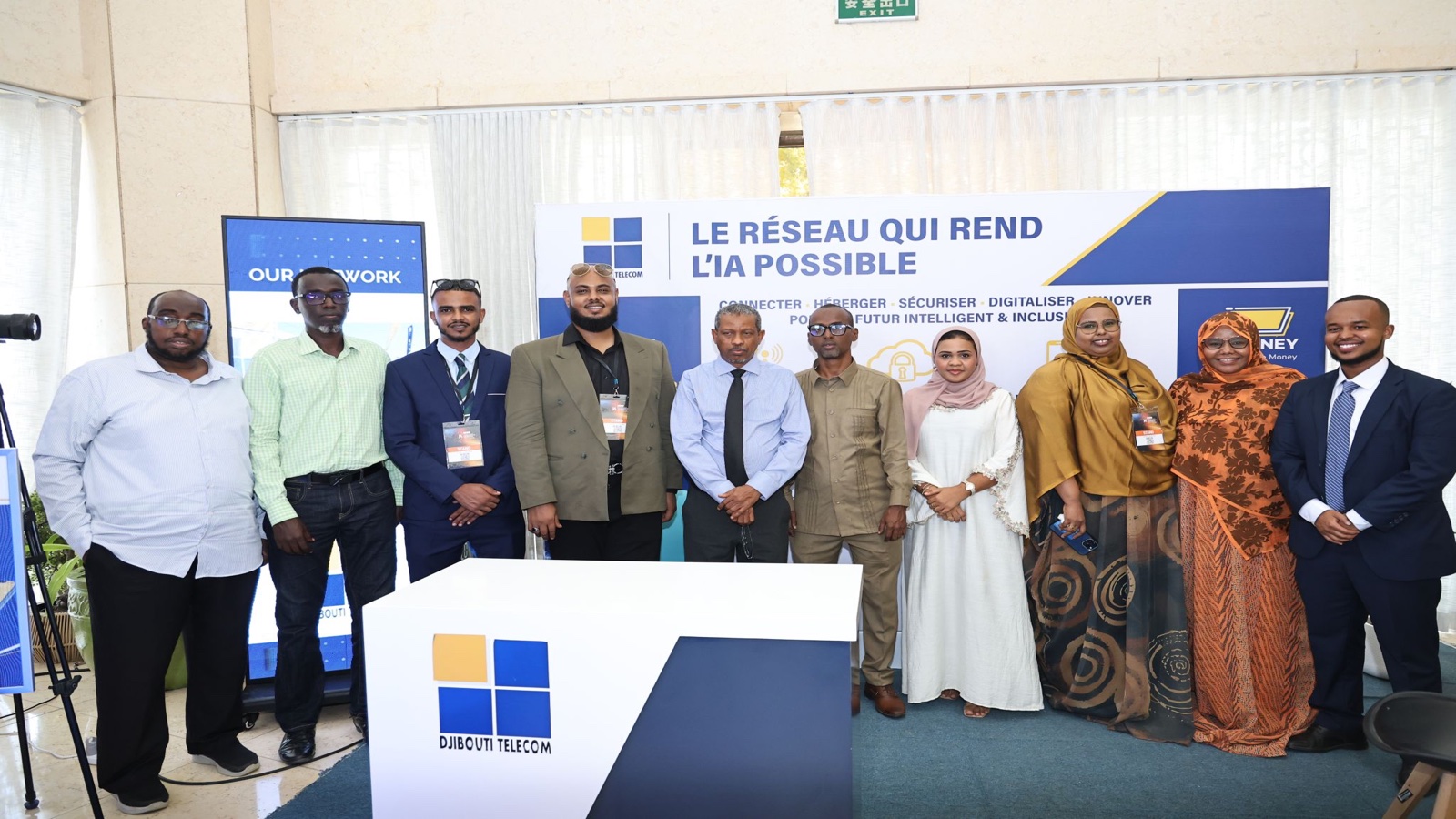
On 2 and 3 September 2026, Djibouti’s first National Forum on Artificial Intelligence brought public institutions, researchers, businesses, technology providers and young innovators to the Palais du Peuple. Held under the high patronage of President Ismaïl Omar Guelleh, the two-day programme combined policy discussions with demonstrations, an exhibition and a national prototyping competition. Djibouti Telecom participated as Gold Sponsor and presented the network and digital services on which AI applications depend.
A National Agenda Takes Shape
On the second day, Djibouti presented the broad directions of its first National Artificial Intelligence Strategy for 2026–2030. The Agence Djiboutienne d’Information state the work covers governance, cybersecurity, skills, research, innovation and inclusion. Across the forum, participants examined public services, economic development, education, sovereign data and the need for digital tools that work in Somali, Arabic and Afar.
The exhibition gave these policy discussions a practical setting. Researchers, startups and companies demonstrated locally developed applications, while the stands gave participants space to compare ideas, discuss implementation and form working relationships. The presence of the President, the Prime Minister, the President of the National Assembly and members of government reflected the national importance given to the subject.
In his opening address, President Guelleh connected the country’s established role in subsea connectivity with its ambition for AI. Djibouti, he said, must now do for data and algorithms what it has done for submarine cables and containers. He also placed sovereignty at the centre of the agenda: AI capacity needs national infrastructure, local skills, governed data and the ability to decide how systems are used.
The Network Behind AI
Kassim Mahamoud Wais, Acting Director General and Director of Infrastructure at Djibouti Telecom, made the infrastructure case directly. In his forum remarks, he said AI requires connectivity and supporting infrastructure, alongside a high-level regulatory framework. He described Djibouti Telecom’s intended role as wider than carrying data. The operator should also support the platforms and services through which that data can be organised and used, working with public institutions, businesses and researchers to build national capacity.
Farhan Mohamed Bouh, Technical Strategy Adviser to the Director General, also represented Djibouti Telecom as a panellist in the session on AI, innovation, economic transformation and business resilience. His participation brought the operator’s experience of telecoms and public-sector digital transformation into a discussion focused on how organisations can apply AI in practice.
At its stand, Djibouti Telecom showed what the infrastructure chain looks like: 5G and fibre access; national and submarine networks; data-centre, hosting and cybersecurity services; and D-Money and digital payment services. Each layer answers a different requirement. Submarine cables provide international reach, national networks connect users and institution, data-centre and hosting capacity place applications and data closer to where they are used whilst security and governance determine how those assets can be trusted.
The forum set a direction, but implementation will be the real test. Djibouti Telecom’s contribution is to keep building and operating the communications and hosting foundation, while working with government, research and business so useful AI services can move from prototypes into everyday use.